Is Title Insurance Required in Georgia?
Is title insurance required in Georgia? A lender’s policy usually is with a loan. An owner’s policy is your choice. See how both fit your closing decision.
· 11 min read

Written by Tony Caroway.
If you are buying a house in Rome, Floyd County, or a nearby Georgia county, someone will ask whether title insurance is required in Georgia. The short answer is no for an owner’s policy. Georgia does not make a home buyer or seller buy one. A mortgage lender almost always requires a separate lender’s policy when the purchase is financed. A cash buyer does not have that lender requirement, but a cash purchase can still leave old title problems behind.

Request a closing with Caroway Law, or call (706) 506-0362.
This is general information about residential closings, not legal advice for a particular contract or property. A policy also does not replace a title review. The search looks for problems before you sign. Insurance is a contract about certain covered problems that still show up later.
Is Title Insurance Required in Georgia for a Home Purchase?
Start with the two policies people mix up. An owner’s title insurance policy protects the owner. A lender’s title insurance policy protects the lender, and only up to the loan balance. The American Land Title Association describes the owner’s policy as the buyer’s choice and the lender’s policy as something the lender almost always requires.
Georgia has no general statute that says a residential buyer or seller must purchase an owner’s policy. The Office of the Commissioner of Insurance and Safety Fire licenses title insurers and agents in Georgia. Licensing is not the same thing as a purchase mandate for a home buyer. Your contract, your lender, and the coverage you choose still decide what gets ordered.
That is why the honest answer depends on how you are buying:
- Financed purchase. The lender’s policy is usually required by the lender. The owner’s policy is still optional unless your contract says otherwise.
- Cash purchase. There is no lender to require a lender’s policy. An owner’s policy is still a choice, not a state requirement.
- Seller side. A seller is not generally required by Georgia law to buy the buyer’s owner’s policy. Local custom and the contract can still put that cost on the seller.
Caroway Law concentrates on residential closings for buyers and sellers. The office is at 414 E. 1st Avenue in Rome, with a large parking lot on the property. Kellie Pearson, the closer and office manager, is often the person who gets the title order moving once an agent or lender sends the contract. Typical title examination turnaround is 48 hours or less, and the firm works with First American Title Insurance Company and Chicago Title Insurance Company. Those details help a file move. They do not change the legal answer about what the state requires.
What a Lender’s Policy Covers, and What It Does Not
When a buyer borrows money, the lender wants its lien to be valid and in the position the loan expects. The lender’s policy is written for that interest. If a covered title problem later threatens the lien, the policy is there for the lender, not for the family’s equity.
Coverage generally tracks the loan. As the buyer pays the balance down, the lender’s protection shrinks with it. When the loan is paid off or refinanced, that policy does not keep protecting the owner. A refinance usually means a new lender’s policy for the new loan. The old owner’s policy, if one was bought, is a different contract and often stays with that owner for as long as they have an interest in the property.
A lender’s policy also does not do the title work. Before closing, someone still has to examine the public record. In Georgia, deeds, liens, and plats are kept through the clerks of superior court and the statewide system run by the Georgia Superior Court Clerks’ Cooperative Authority. A search can find a judgment, an old mortgage, a missing heir, or a deed that does not match the legal description. The point of that work is to clear what can be cleared before money changes hands.
Insurance is the backstop for covered matters the search did not catch. It is not a promise that every future dispute is covered, and it is not a substitute for reading the exceptions on the commitment. Those exceptions, premium amounts, and who customarily pays are their own questions. This guide stays on the requirement.
Why an Owner’s Policy Is a Separate Decision
An owner’s policy is the one people mean when they ask, “Do I have to buy title insurance?” You do not have to. Many Georgia buyers still choose it because the deed alone does not insure the title.
The deed transfers whatever interest the seller can convey. It does not, by itself, pay you if a forgery, an unpaid lien, or a missing signature turns up after you move in. Those problems can sit in the chain of title for years. A careful search lowers the chance. It cannot promise the record is perfect.
Common risks an owner’s policy is meant to address include:
- A prior owner deeded the property with a signature that was forged or signed by someone who lacked authority.
- A contractor’s lien or a judgment was missed, misindexed, or recorded in a way the search did not catch.
- An heir or former spouse later claims an interest that never appeared clearly in the deed book.
- A recording error or a wrong legal description puts the boundary or the chain of title in doubt.
None of that is a reason to skip the search. At Caroway Law, title examination is part of getting a residential file ready for the closing appointment. The team reviews the title information, coordinates with the real estate agent and the lender, and walks the parties through signing. Recording the deed comes after the papers are signed and the funds are in place. An owner’s policy, if the buyer wants one, sits beside that work. It does not replace it.
A cash buyer sometimes assumes the question disappears because there is no loan. The lender’s requirement disappears. The title risk does not. A cash closing in Floyd County, Polk County, Gordon County, Walker County, Bartow County, or Paulding County still depends on the same public records. The buyer can still decide that an owner’s policy is worth having, or can decide to go without it after seeing the title work.
How the Choice Shows Up on a Georgia Closing
You should see title insurance discussed before the closing appointment, not as a surprise at the table. On a financed purchase, the lender’s instructions say whether a lender’s policy must be issued. The owner’s policy shows up as its own line if someone is buying it. If nobody ordered an owner’s policy, you should not assume the lender’s policy covers you.
A simple way to sort the paperwork:
- Read the contract for any promise about title insurance. Some North Georgia contracts say the seller will pay for an owner’s policy. Some are silent. The contract controls that deal.
- Ask which policy is the lender’s and which, if any, is the owner’s. The names look similar. The insured party is the difference that matters.
- Look at the title work itself. A clear search is good news. It is still not the same document as a policy.
- Ask what the policy does not cover. Standard exceptions and any property-specific exceptions belong in that conversation. A later guide can walk through exceptions line by line. For this decision, you only need to know they exist.
- Decide on the owner’s policy before the closing package is final. Changing it on signing day creates avoidable delay for the agent, the lender, and the closer.
If a title contingency in a Georgia real estate contract is in play, that clause is about objecting to title and giving the seller a chance to cure. It is not title insurance. Clearing an objection gets the deal to closing. A policy, if purchased, addresses certain covered defects that remain after closing.
The people around the file have different jobs. The agent negotiates the contract and keeps the buyer and seller moving. The lender sets loan conditions, including the lender’s policy. A title company may gather the search package, order payoffs, and help prepare documents. A Georgia closing attorney reviews the title, handles the closing, and sees the deed through recording. Caroway Law’s piece is that closing work for residential buyers and sellers. You can read more about what a title company does at closing without treating that role as a substitute for the attorney or for an owner’s policy.
Lender’s Policy and Owner’s Policy Side by Side
Use this comparison when someone in the transaction says “title insurance is required” without saying which policy they mean. Every sentence in the table is about the requirement, not about price.
| Question | Lender’s policy | Owner’s policy |
|---|---|---|
| Who is protected? | The lender’s lien is protected. | The owner’s title interest is protected. |
| Is it required in Georgia? | The state does not require it, but the lender usually does. | No. It is optional unless the contract requires it. |
| Does a cash closing need it? | No lender means no lender’s policy. | Still optional. Cash does not erase title risk. |
| How long does it last? | It tracks that loan, then ends when the loan ends. | It generally lasts while that owner has an interest. |
| Does it replace the title search? | No. The search still happens first. | No. The search still happens first. |
If your question is really about the premium, that is a different article. Dollar amounts change with the price, the insurer, and whether both policies are issued together. This page will not guess a number. The same is true for who pays. In many Georgia deals the seller pays for the owner’s policy and the buyer pays for the lender’s policy, but that is custom, and the contract can say something else.
What to Ask Before You Decide
Bring these questions to the closing attorney, not to a generic checklist. The useful answers come from your file.
- Is there a lender’s policy on this loan, and who is the insured?
- Has anyone ordered an owner’s policy, and does the contract require one?
- What did the title examination find, and what is still open?
- Which exceptions will stay on the policy if we buy one?
- If we skip the owner’s policy, what risk stays with the buyer after recording?
For a buyer in Floyd County or a surrounding county, the practical path is straightforward. Send the contract early. Let the title examination run. Then decide on the owner’s policy with the search in front of you, not from a rumor about what Georgia “always” requires.
Sellers can use the same facts. You are not automatically on the hook for a policy just because the buyer has a loan. You are on the hook for what the contract says, and for delivering the title the contract promises. If a lien has to be paid or a deed has to be corrected, that work happens in the file. Insurance does not erase a known defect you agreed to cure.
Caroway Law helps buyers, sellers, agents, and lenders with that residential closing work from the Rome office. Hours are Monday through Friday, 9 a.m. to 5 p.m. Eastern, closed weekends and federal holidays. When you are ready, request a closing with a residential closing attorney and send the property address, your role, and the timing you need. Agents and lenders can include the contract or the loan details so the file can be opened.
Ready for the closing conversation? Call (706) 506-0362 or request a closing.
FAQ: Is Title Insurance Required in Georgia?
Is owner’s title insurance required in Georgia?
No. Georgia does not require a home buyer or seller to buy an owner’s title insurance policy. A lender can still require its own lender’s policy when the purchase is financed, and a contract can still say that an owner’s policy will be provided.
Does a mortgage mean I already have owner’s coverage?
No. The lender’s policy protects the lender’s lien. It does not protect your equity, and it ends when that loan ends. If you want owner’s coverage, it has to be its own policy.
Do cash buyers in Georgia need title insurance?
They are not required to buy it. A cash purchase has no lender’s policy unless someone adds one for another reason. The buyer can still choose an owner’s policy after the title examination, because cash does not remove old liens, forgeries, or recording errors.
Does title insurance replace a title search?
No. The search and the attorney’s review look for problems that can be fixed before closing. A policy is a contract about certain covered problems that surface later. One does not stand in for the other.
Who can help me sort this out on a North Georgia closing?
Caroway Law handles residential closings for buyers and sellers from its Rome office and works with agents and lenders across Floyd County and nearby counties. Call (706) 506-0362 or use the contact page to request a closing. This article is general information, not legal advice for your transaction.
Published by Caroway Law in Rome, GA. Articles are general information on Georgia residential closings, not legal advice for your situation. Questions? Call 706-506-0362.
More articles
Seller Closing Documents in Georgia: A Practical Guide
Learn which seller closing documents may arise in Georgia, what to review, and how to coordinate with your agent, lender, and closing attorney.
Read articleTemporary Occupancy Agreement for a Seller After Closing in Georgia
Plan a Georgia seller’s stay after closing with clear dates, access, utilities, insurance questions, and a defined move-out process for both parties.
Read article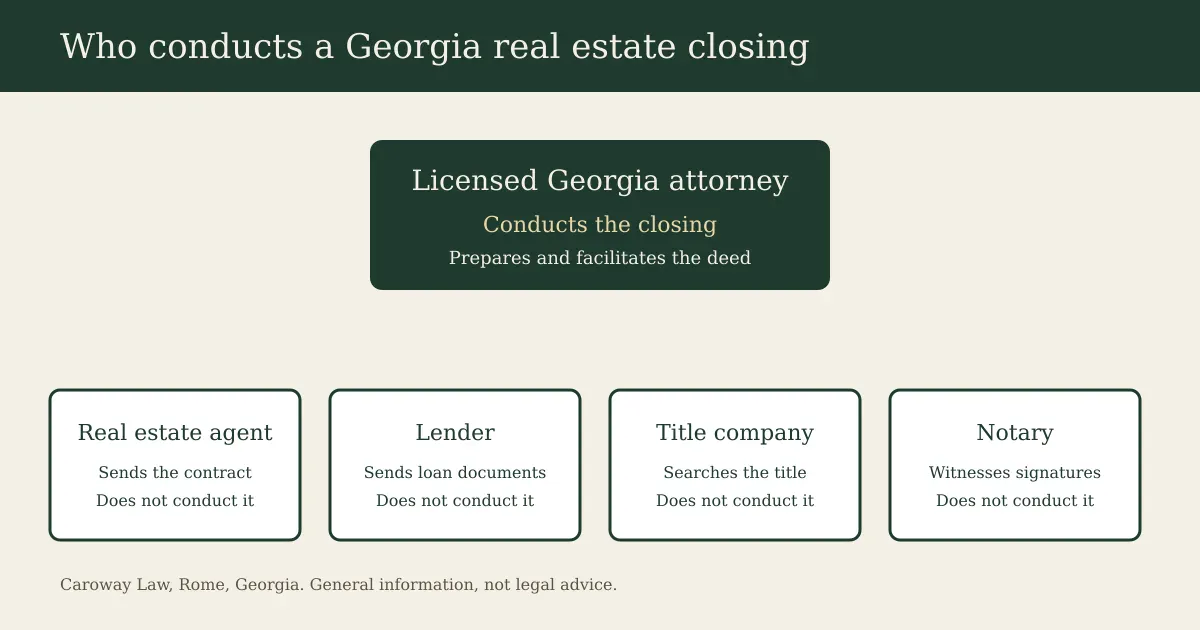
Who Can Conduct Real Estate Closings in Georgia? A Guide
See who can conduct real estate closings in Georgia, why a licensed attorney prepares the deed, and how agents request a closing before the date is set.
Read article