Title Contingency in a Georgia Real Estate Contract
See how a title contingency in a Georgia real estate contract works, from the buyer’s first title objection to the seller’s cure, credit, or extension.
· 12 min read

A title contingency in a Georgia real estate contract is the buyer’s written right to check the title and step back, or ask for a fix, if the check finds a problem. For a seller, it is the part of the deal that can pause a closing even after the price is set. The contract, not a custom, decides the deadline, what counts as a problem, and what happens next.
Request a closing at (706) 506-0362
This guide is general information for Georgia home sellers, buyers, and the agents who send them, not legal advice. Your signed contract controls your file. Caroway Law concentrates on residential closings in Floyd County and nearby Georgia counties, and we read the clause against that contract before anyone signs a deed.
Once the contract is signed, send the full file and request a closing so the title search starts while the objection clock is still open. Waiting until the last week leaves little time to cure what the search finds.
What a Title Contingency in a Georgia Real Estate Contract Does
Think of the clause as a promise with a checkup attached. The seller agrees to convey the kind of title the contract names. The buyer gets a set time to look at the public records and say whether that title is acceptable. If the buyer stays quiet through the deadline, the contingency usually ends and the sale moves on.
Georgia forms do not all use the same words. Many residential deals use a Georgia Association of REALTORS purchase and sale agreement, and the title language may sit in the printed form or in a special stipulation the parties added. Other deals use a builder contract or an attorney-drafted agreement. Read the pages you actually signed.
Three pieces matter more than the heading:
- The title standard. The contract may call for good and marketable title, insurable title, or title a title insurer will insure subject to standard exceptions. Those are not the same promise.
- The deadline. The buyer usually has a set number of days after the binding agreement date to object. Missed days are hard to get back.
- The result of an objection. The contract should say whether the seller must try to cure, whether the buyer may cancel, and who keeps the earnest money.
A title contingency is not the inspection contingency, the financing contingency, or the appraisal contingency. An inspection looks at the house. A title review looks at who owns it and what claims sit on it. Mixing those deadlines is a common way a clean deal gets messy.
How Title Gets Checked Before a Georgia Closing
After the contract is binding, the closing attorney orders a title examination. The search looks at the county land records for the chain of owners, open mortgages, tax liens, judgments, easements, and other matters that could follow the property. In Georgia, deeds are recorded with the clerk of superior court in the county where the land sits.
A later buyer can lose priority to an earlier unrecorded deed only in the situations the recording statute describes. If a release or deed was never put on record, years of living in the house do not make that paper disappear.
The practical result for a seller is simple. If a deed, release, or lien was never recorded, the examiner may not treat the title as clear just because the seller has lived in the house for years. Georgia Code Section 44-2-1 is the recording rule that makes that public file matter. The Georgia Superior Court Clerks’ Cooperative Authority is the statewide index many examiners use to reach those county records.
The examiner then prepares a title commitment or a title report. That paper lists what the insurer is willing to cover and what it will except. Exceptions are not all deal-breakers. A subdivision easement or a standard survey exception may be normal. An open mortgage in the seller’s name, a judgment, or a break in the chain of title usually is not.
Georgia closings are handled by a licensed Georgia attorney. The Georgia Supreme Court approved UPL Advisory Opinion 2003-2 and held that only a licensed Georgia attorney may prepare or facilitate the execution of a deed of conveyance. You can read that ruling in In re UPL Advisory Opinion 2003-2. A title company can search and insure. It does not replace the attorney who prepares the deed. If you want the role split in plain language, see what a title company does at a Georgia closing.
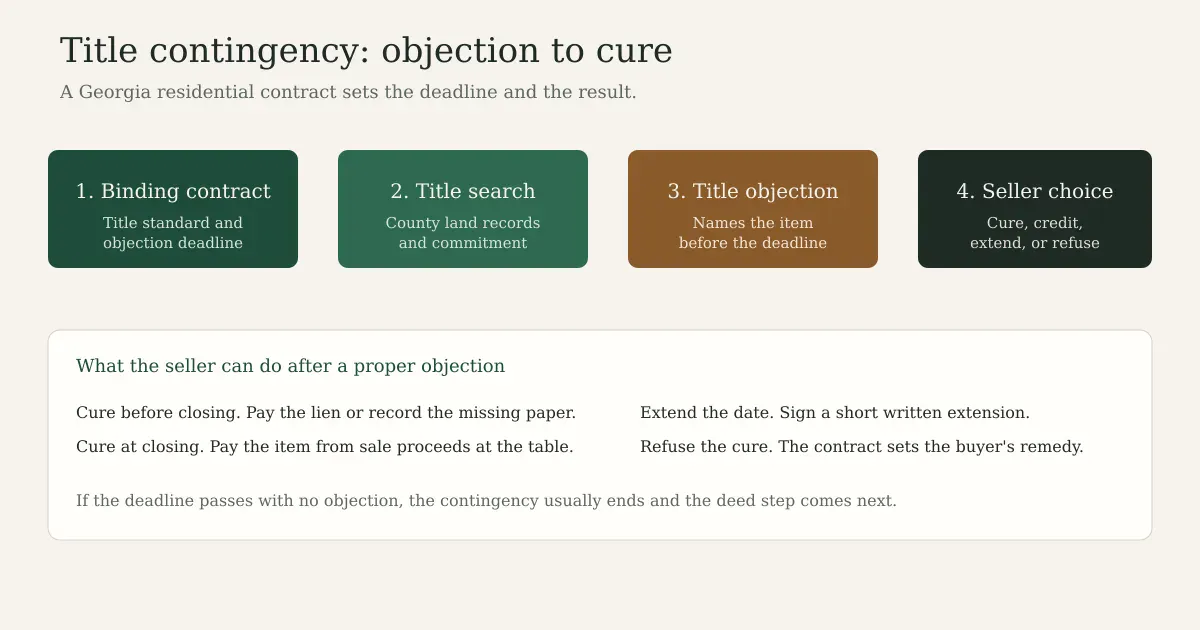
A title objection only matters if it arrives inside the contract deadline. The seller’s next step is one of the written choices.
What Sellers Usually See in a Title Objection
A title objection is the buyer’s notice that the title, as it stands, does not meet the contract. It should name the item and arrive before the deadline. A vague note that “title is not clean” is harder to cure than a note that names the open lien, the missing probate, or the unreleased security deed.
Items that often show up on a residential file include:
- An open mortgage or equity line that still needs a payoff and a recorded cancellation.
- A judgment, tax lien, or HOA lien that has to be paid from the seller’s proceeds.
- A deceased owner still in the chain, with no estate paperwork the examiner can rely on.
- A name variation, a missing middle initial, or a deed that was signed but never recorded.
- An easement, boundary overlap, or access question that a survey would show and the contract treats as a title matter.
Not every cloud is the seller’s job to remove. Many contracts let the buyer object only to matters that make the title unmarketable, and they treat utility easements and subdivision covenants as acceptable. If the contract says that, objecting to a normal power-line easement will not give the buyer a way out.
Survey issues deserve their own sentence in the contract. Some stipulations fold survey defects into the title review. Others give the buyer a separate survey period. If your contract is silent, do not assume a fence in the wrong place is a title objection. Ask the closing attorney to read that section before anyone treats it as one.
The Seller’s Choices After a Title Objection
Once a proper objection arrives, the seller usually has a short list of choices. The contract’s cure language picks the list. These are the paths we see most often on residential files.
| Seller choice. | What it means. | When it fits. |
|---|---|---|
| Cure before closing. | Pay the lien, record a release, or obtain the missing document. | The fix is a payoff, a cancellation, or a paper the seller can get in time. |
| Cure at closing. | Use sale proceeds to pay the item, and have the attorney hold or record the release. | The lender or lien holder will accept a closing-table payoff. |
| Give the buyer a credit or a price cut. | The buyer accepts the title with the item still in place, for money. | The buyer and any lender agree in writing, and the item is truly acceptable. |
| Extend the closing date. | Both sides sign a written extension so the cure can finish. | The cure is real but will miss the current closing day. |
| Refuse and let the contract speak. | The seller will not or cannot cure, and the buyer’s remedy in the contract applies. | The item is not the seller’s to fix, or the cost is more than the contract requires. |
Get the choice in writing. A text that says “we’ll figure it out at the table” is not a cure. If the closing date has to move, use a short extension that names the new date and leaves the rest of the contract in place. Our guide to a Georgia closing date extension agreement covers that paper without turning this article into an extension form.
Earnest money follows the contract too. If the buyer terminates under a live title contingency, the earnest money usually returns to the buyer. If the buyer waits until after the deadline, or objects to something the contract already accepts, the seller may be able to hold the buyer to the deal. That fight is about the words on the page, not about who feels more reasonable.
How to Prepare for a Title Contingency in a Georgia Real Estate Contract
The calmest files start before the buyer writes an objection. A seller who gathers the ownership papers early gives the examiner a head start and often avoids a last-week surprise. The same title contingency in a Georgia real estate contract is easier to live with when the paperwork is already on the desk.
- Pull the recorded deed you received when you bought, and check that your name matches your current ID.
- List every mortgage and equity line, including ones you think are paid off, and note the servicer.
- Mention any estate, divorce, or trust that put this house in your name.
- Tell the closing attorney about boundary disputes, shared driveways, and old surveys.
- Ask, early, which title standard your contract actually uses.
Payoffs need lead time. A lender can take days to issue a payoff letter, and a release can take longer to come back for recording. Waiting until the week of closing to order that letter is how a curable lien becomes a delayed closing.
If you already know about a defect, say so before the contract is signed. A seller disclosure, or a special stipulation that names the item and says the buyer accepts it, is cleaner than a fight after the objection deadline. Hiding a known lien does not make it disappear from the land records.
Buyers and agents can help the same file. Send the fully signed contract, including every stipulation, to the closing office as soon as it is binding. A title order is the work request that starts the search. Request a closing when the contract is in hand, not the week the objection period ends. If you are selling in Floyd County, the Floyd County closing attorney page explains how local residential files are handled. Statewide residential closing help sits on the residential closing attorney page.
What Happens to the Deed if the Title Clears
When the objection is cured or the deadline passes without one, the seller still has to sign a deed that matches the contract. In a typical Georgia home sale that deed is a warranty deed or a limited warranty deed. The seller signs it at the closing table, the attorney handles the formalities, and the deed is recorded in the county where the land lies.
Recording is what puts the world on notice of the buyer’s ownership. Georgia Code Section 44-2-14 sets the recordation requirements, including that the instrument be an original and be attested or acknowledged as the law requires. A deed that never gets recorded can leave the next buyer, and the seller, with a title question later.
The deed transfer itself is a separate step from the contingency. If you want the recording path in more detail, read how to transfer a property deed in Georgia. This article stays on the contract clause that has to be satisfied before that deed should be signed.
One more limit is worth stating. This guide does not walk through a quiet title lawsuit, a title-insurance claim, or a full title-search checklist. Those are different jobs. If the examiner finds a break that money at the closing table cannot fix, the next step is a conversation with the closing attorney about whether the contract still requires a cure.
Ready to start the file? Request a closing or call (706) 506-0362 and send the signed contract.
FAQ About a Title Contingency
Does every Georgia home contract have a title contingency?
No. Many Georgia Association of REALTORS residential forms include title language, and many deals add a special stipulation. A builder contract or an attorney-drafted agreement may handle title differently. Read the contract you signed, including the stipulations, before you assume the buyer has a title out.
How long does the buyer have to object to title?
The contract sets the clock. It is often a number of days after the binding agreement date, and it is not the same number on every form. If the contract is blank or the parties struck the printed language, do not guess. Ask the closing attorney to count the days from the date the agreement became binding.
Can a seller refuse to cure a title objection?
Sometimes. The contract may require the seller to cure items up to a stated effort or cost, and it may let the seller refuse items outside that promise. If the seller cannot or will not cure, the buyer’s remedy is whatever the contract says, which may include canceling and receiving the earnest money back.
Is a title contingency the same as title insurance?
No. The contingency is a contract right to review title and object. Title insurance is a policy the buyer or lender buys at closing. The title commitment used during the review is the insurer’s offer of that policy, and its exceptions are often what the objection is about. The policy itself is a different product.
Who should a seller call when a title objection arrives?
Call the closing attorney on the file and send the objection the same day. Bring the contract, the payoff contacts, and any estate or divorce papers tied to the house. An early call is what leaves time to pay a lien, record a release, or sign an extension before the closing date.
Written by Tony Caroway.
Published by Caroway Law in Rome, GA. Articles are general information on Georgia residential closings, not legal advice for your situation. Questions? Call 706-506-0362.
More articles
Is Title Insurance Required in Georgia?
Is title insurance required in Georgia? A lender’s policy usually is with a loan. An owner’s policy is your choice. See how both fit your closing decision.
Read articleSeller Closing Documents in Georgia: A Practical Guide
Learn which seller closing documents may arise in Georgia, what to review, and how to coordinate with your agent, lender, and closing attorney.
Read articleTemporary Occupancy Agreement for a Seller After Closing in Georgia
Plan a Georgia seller’s stay after closing with clear dates, access, utilities, insurance questions, and a defined move-out process for both parties.
Read article