Who Can Conduct Real Estate Closings in Georgia? A Guide
See who can conduct real estate closings in Georgia, why a licensed attorney prepares the deed, and how agents request a closing before the date is set.
· 11 min read
Written by Tony Caroway.
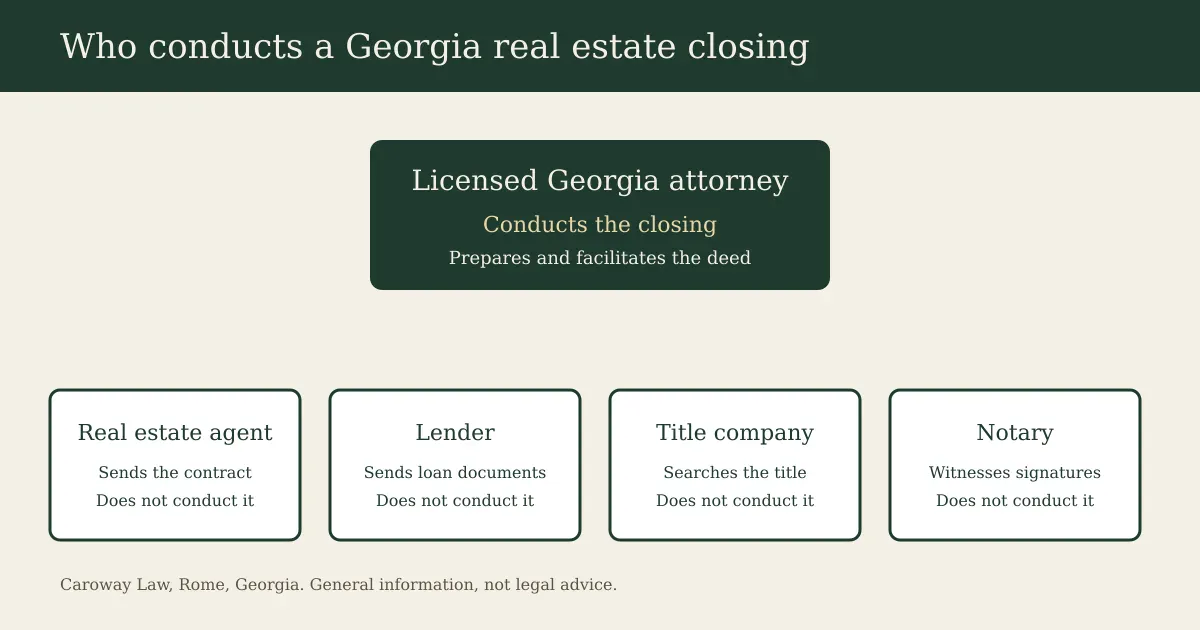
If you are lining up a house in Rome or a nearby county, the practical question is who can conduct real estate closings in Georgia. A real estate agent, a lender, a title company, and a notary can each touch the file. Only a licensed Georgia attorney conducts the closing. The Georgia Supreme Court has said that someone other than a licensed Georgia attorney may not close a real estate transaction or prepare and facilitate the deed.
Call (706) 506-0362 to request a closing
This is general information about Georgia residential closings, not legal advice about your contract. Caroway Law concentrates on residential closings for buyers, sellers, agents, and lenders in Floyd County and nearby counties. We do not focus on litigation or commercial work.
Who can conduct real estate closings in Georgia
A licensed Georgia attorney conducts the closing. The Georgia Supreme Court approved that rule in In re UPL Advisory Opinion 2003-2, 277 Ga. 472 (2003). The Court agreed with the State Bar that only a licensed Georgia attorney may prepare a deed of conveyance for someone else or facilitate its execution. The same opinion says it is the unauthorized practice of law for anyone else to close the transaction or to prepare or facilitate the deed.
You can read the Court's opinion on the State Bar of Georgia site. The deeds named in that opinion include a warranty deed, a limited warranty deed, a quitclaim deed, a security deed, and a deed to secure debt. Those are the papers that move ownership and secure a loan. A closing is the legal work around those papers, not only the hour people sit down to sign.
The opinion also covers witness-only closings. In that setup, a non-lawyer runs the signing and a lawyer is not there to prepare or facilitate the deed. Georgia does not treat that as a proper closing. The attorney has to be part of preparing the deed and seeing it executed, not a name added after the fact.
That answer is statewide. It is the same in Floyd, Bartow, Gordon, Polk, Walker, and Paulding counties. Local custom can change who sits at the table. It does not change who may conduct the closing.
People sometimes hear "attorney closing state" and picture a rule that only lawyers may be in the room. That is not what the opinion says. Agents, lenders, and title staff belong in the work. The line is about who closes the transaction and who prepares or facilitates the deed. Crossing that line is treated as the unauthorized practice of law, even when everyone at the table is trying to be helpful.
The opinion also points back to earlier State Bar guidance. A lawyer may not hand the closing of a real estate transaction off to a non-lawyer. The attorney remains responsible for that closing. Hiring a signing service, or asking the title company to "just get it signed," does not move that responsibility.
What the attorney does, from order to recording
Conducting the closing means doing the legal work that finishes the transfer. On a typical residential file, that work includes the deed, the settlement figures, and the steps that get the signed deed ready for the courthouse. It is not the same job as finding the house, approving the loan, or searching the title.
At Caroway Law, the attorney-led closing process starts when an agent or lender sends a title order or a sales contract. The office is at 414 East 1st Avenue in Rome, with a large parking lot on the property. It is open weekdays from 9 a.m. to 5 p.m. Eastern. Tony Caroway has handled more than 2,000 real estate closings, including years as in-house claims counsel with First American Title Insurance Company.
Here is the short sequence on a file we conduct:
- An agent or lender sends the title order or the sales contract.
- Kellie Pearson, closer and office manager, receives the order and gets the file moving.
- The office reviews the contract and title information and coordinates the papers the parties will sign.
- The attorney prepares the deed and facilitates the signing. Loan documents, if any, are signed at the same appointment.
- After the appointment, the signed deed goes to the Clerk of Superior Court in the county where the land sits.
- The clerk records the deed. Keys can change hands before that recording is finished.
Georgia keeps a statewide real property index through the Georgia Superior Court Clerks' Cooperative Authority. Clerks of Superior Court send deed, lien, and plat records into that system, including book and page, grantor and grantee, and transfer-tax data. Recording is how the signed deed becomes part of the public record. It is a separate step from the signing itself.
A reader who wants the shorter question, whether Georgia expects an attorney on the file at all, can start with our note on whether Georgia requires an attorney for a real estate closing. This page answers the next question: who is allowed to conduct it.
Who can help, and who cannot conduct it
Plenty of people belong on a closing file. Belonging on the file is not the same as conducting the closing. The table below is the split we use when an agent or a lender asks who should do what.
| Role. | Can help with. | Does not conduct the closing. |
|---|---|---|
| Licensed Georgia attorney. | Prepares the deed and facilitates signing. | This is the person who conducts it. |
| Real estate agent. | Negotiates the contract and sends the title order. | Does not prepare the deed or close the file. |
| Lender. | Approves the loan and sends loan documents. | Does not conduct the closing for the parties. |
| Title company. | Searches title and helps with payoffs. | Does not take the attorney's place at closing. |
| Notary. | Confirms identity and witnesses signatures. | A notary stamp is not a closing. |
Agents are often the first call. A busy agent who closes a fair number of homes will send the contract, the contact list, and the target date. That request starts the work. It does not make the agent the closer.
Lenders control the loan. They set conditions, prepare loan documents, and say when the file is clear to close. They still do not conduct the real estate closing. Loan documents and the deed are different papers, even when they are signed at the same table.
A title company can search the record, gather a title package, and help with payoff figures. Our guide to what a title company does at closing covers that support work. The company does not step into the attorney's role of preparing and facilitating the deed.
A notary can confirm identity and witness a signature. Witness-only signing, with no lawyer preparing or facilitating the deed, is one of the practices the Supreme Court rejected. If you live out of state, ask early how your signatures will be handled. Do not assume a mail-away notary replaces the attorney.
How a Georgia residential closing is usually staffed
On most home sales we see, one closing attorney conducts the closing for the transaction. Buyers and sellers do not each have to hire a separate lawyer as a starting rule. Who the attorney represents, and what the engagement covers, should be clear before signing day. Ask that question directly if it is not already in writing.
The people in the room are a different list from the person who conducts the closing. A buyer, a seller, an agent, or a lender's representative may attend. Some of them may not need to attend at all. Our guide to who attends a real estate closing covers that attendance list. Attendance does not grant authority to prepare the deed.
Cash sales and financed sales follow the same rule on who conducts the closing. A cash buyer still needs a deed prepared and facilitated by a Georgia attorney. A financed buyer has loan documents on top of that deed. The extra lender paperwork does not move the closing role from the attorney to the lender.
If you want a local starting point, our Floyd County closing attorney page covers buyers in Rome and Floyd County. Families buying in Cartersville and Bartow County can use the Bartow County home closing attorney page. Both sit under the same statewide rule about who conducts the closing.
What to send when you request a closing
The useful request is a title order or a sales contract, not a general question about fees. That is how Caroway Law opens a residential file. Send it by email, or bring it by the Rome office. Kellie Pearson, closer and office manager, receives title orders and gets the file moving.
Include these items so the office can tell who is conducting the closing and who is only supporting it:
- The property address and county.
- Whether you are the buyer, seller, agent, or lender.
- The sales contract or the title order.
- The target closing date and any deadline already in the contract.
- Names and emails for the agent, the lender, and the other party.
- Any known title issue, such as an estate, a name mismatch, or a prior lien.
If a legal question shows up close to closing, raise it with the closing attorney. An agent can explain the business deal. An agent cannot give legal advice about the contract. A lender can explain the loan. A lender cannot prepare the deed in the attorney's place.
Questions to ask before you pick who conducts it
Ask these before the date is set, not in the parking lot. The answers tell you whether a licensed Georgia attorney is actually conducting the closing.
- Who is the Georgia attorney conducting this closing?
- Will that attorney prepare the deed, or only review a deed someone else drafted?
- Who does the attorney represent: buyer, seller, lender, or more than one party?
- Will a non-lawyer run the signing without the attorney facilitating the deed?
- Who is responsible for sending the signed deed to the clerk for recording?
A clear answer sounds like a lawyer's name, a Georgia bar admission, and a description of the deed work. A vague answer sounds like "the title company handles everything" or "a notary will meet you." Those can be fine as support. They are not an answer to who conducts the closing.
Agents who send a lot of Rome and North Georgia files usually ask this once per company, then reuse the answer. If the company changes, or a new signing service appears on the confirmation, ask again. The person who conducted the last closing is not automatically the person conducting this one.
Out-of-state buyers run into this more often. A closer from another state may be excellent at lender paperwork and still not be the Georgia attorney who can prepare and facilitate the deed. If the confirmation email lists only a notary or a remote signing time, call the closing office before you travel. It is easier to fix the setup a week out than the afternoon of signing.
Sellers should ask the same questions. The deed is the seller's document in an ordinary sale. Who prepares it still has to be a licensed Georgia attorney, even when the buyer chose the closing office. Do not sign a deed that arrived from a party you cannot tie back to that attorney.
Request a closing with the property address, your role, and your timing. You can also call (706) 506-0362.
FAQ: who conducts a Georgia closing
Can a title company conduct a real estate closing in Georgia?
No. A title company can search title, collect payoff figures, and help prepare the package. It cannot conduct the closing or prepare and facilitate the deed in place of a licensed Georgia attorney.
Can a notary conduct the closing if an attorney prepared the papers?
No. Notarizing a signature is not the same as conducting the closing. The Supreme Court rejected witness-only closings, where a non-lawyer handles execution of the deed without the attorney facilitating it.
Can my real estate agent conduct the closing?
No. Your agent can negotiate the contract, send the title order, and sit with you at signing. Conducting the closing, including the deed, stays with a licensed Georgia attorney.
Does each buyer and seller need a separate closing attorney?
Not as a general rule. One attorney often conducts the closing for the transaction. Ask who that attorney represents and what the engagement covers before you sign.
Who conducts a cash closing?
A licensed Georgia attorney still conducts a cash closing. Skipping the lender removes loan documents. It does not remove the deed or the duty to have an attorney prepare and facilitate it.
Request a closing in Rome
If you already know the property and the date, request a closing with Caroway Law. Call (706) 506-0362 or use the contact page. Share the address, whether you are buying or selling, and the contract or title order. We will tell you what the file needs next.
This article is general information about Georgia practice. It is not legal advice for a particular contract, and it is not a promise about your closing date.
Published by Caroway Law in Rome, GA. Articles are general information on Georgia residential closings, not legal advice for your situation. Questions? Call 706-506-0362.
More articles

Is Title Insurance Required in Georgia?
Is title insurance required in Georgia? A lender’s policy usually is with a loan. An owner’s policy is your choice. See how both fit your closing decision.
Read articleSeller Closing Documents in Georgia: A Practical Guide
Learn which seller closing documents may arise in Georgia, what to review, and how to coordinate with your agent, lender, and closing attorney.
Read articleTemporary Occupancy Agreement for a Seller After Closing in Georgia
Plan a Georgia seller’s stay after closing with clear dates, access, utilities, insurance questions, and a defined move-out process for both parties.
Read article