What Is Escrow in Real Estate? A Georgia Homebuyer Guide
Learn what is escrow in real estate in Georgia, including earnest money, lender accounts, closing documents, timing questions, and closing-date changes.
· 11 min read

Written by Tony Caroway.
Call (706) 506-0362 to request a closing
If you are buying or selling a home in Georgia, you may hear the word “escrow” several times. It can describe money held during the transaction. It can also describe a mortgage account used for property taxes and homeowners insurance. Those are related ideas, but they are not the same account.
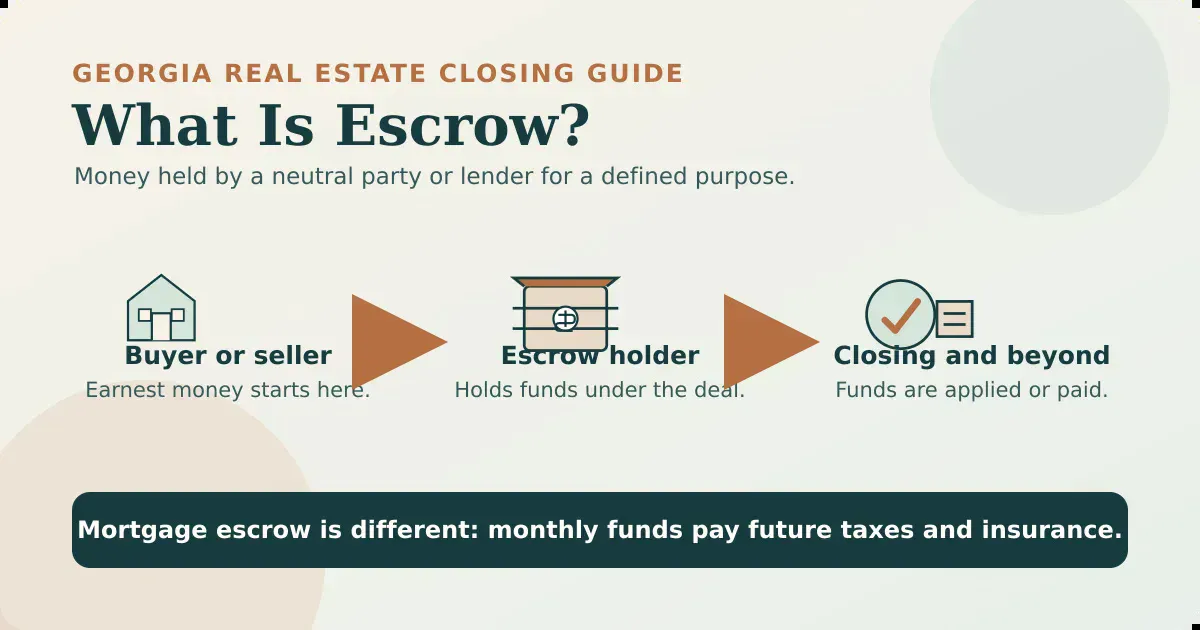
This guide explains what is escrow in real estate in plain English. It focuses on a typical residential purchase and the questions that come up around earnest money, documents, and closing dates. If a closing date needs to move, our closing timeline guidance is a helpful next read. A contract, loan, or closing file can have terms that change the answer. This article is general information, not legal advice for a particular transaction.
What Is Escrow in Real Estate?
Escrow is a controlled holding arrangement. Money or documents are placed with a neutral party until stated conditions are met. The holder then applies, delivers, or returns those items according to the contract, closing instructions, loan terms, or another governing document.
In a home purchase, escrow is meant to keep important funds from going directly to one side too early. The buyer may deposit earnest money after the purchase agreement is accepted. The money can remain with an escrow holder while inspections, financing, title work, and other contract steps move forward. At closing, it may be credited toward the buyer’s required funds.
The Georgia Attorney General’s Consumer Protection Division explains that an earnest-money deposit may be held by a third-party escrow or title company until the sale is final. That is a useful starting point, but the purchase contract still matters. It may address the amount, holder, deadlines, contingencies, and what happens if the transaction does not close.
Two Common Meanings of Escrow in a Georgia Home Purchase
People often use “escrow” to describe two different stages of owning a home. The first usually concerns the purchase contract and earnest money. The second usually begins with the mortgage payment after closing.
| Type of escrow | When it is used | What it generally does |
|---|---|---|
| Earnest-money escrow. | After the purchase agreement and before closing. | Holds the buyer’s deposit under the contract until it is credited, returned, or otherwise addressed. |
| Mortgage escrow. | During the loan after closing. | Collects part of the monthly payment for future property taxes and homeowners insurance. |
| Closing escrow. | At or immediately around the closing. | Helps organize funds, payoff amounts, documents, and recording steps before completion. |
These categories can overlap in conversation. They should not be treated as interchangeable. A buyer asking whether earnest money is safe before closing is asking about the purchase contract and its escrow holder. A buyer asking why the monthly mortgage payment changed is usually asking about lender escrow.
How Earnest-Money Escrow Works Before Closing
Earnest money is a good-faith deposit connected to a purchase agreement. It shows that the buyer intends to perform, but it is not automatically the seller’s money on the day it is deposited. The purchase agreement and applicable instructions control how the deposit is handled.
A typical sequence looks like this:
- The buyer and seller sign a purchase agreement.
- The agreement identifies an earnest-money amount and the required delivery deadline.
- The buyer delivers the funds to the named holder.
- The holder keeps the funds while the transaction follows its contract timeline.
- At closing, the funds may be credited toward the buyer’s amount due.
The timeline can look different when the contract includes contingencies. Financing, inspection, appraisal, title, and other provisions may give a party specific rights or deadlines. A missed deadline can matter. So can a written notice, an amendment, or a request to extend the closing date.
If the transaction does not close, the escrow holder may not be able to release the funds based on one person’s request alone. The contract may require mutual written instructions, a release form, a settlement, or another process. The right answer depends on the documents and facts in the file. Do not assume that the deposit automatically goes to the buyer or seller.
That is one reason clear communication matters. If a buyer and seller disagree about a release, the escrow holder may need to hold the money until the dispute is resolved. A real estate agent, lender, or closing lawyer can explain the next procedural step. An attorney can address legal questions about a specific contract.
What Escrow Can Have to Do With Closing Documents
Escrow is connected to documents because the holder needs written authority to receive, apply, or release funds. The purchase agreement is usually the first place to look. Other important documents can include amendments, earnest-money receipts, lender instructions, payoff statements, settlement statements, and closing disclosures.
For a buyer, the final figures should make clear how the earnest-money credit affects the amount needed to close. The credit may appear with other items that affect the settlement total. It should not be confused with a lender’s future tax and insurance reserves.
For a seller, the closing paperwork may show the deposit as part of the funds being applied to the transaction. The seller may also see payoff information, prorations, fees, and other adjustments. Those items are separate from the question of whether a deposit was properly held before closing.
Read the documents as a group. A number on a settlement statement does not replace the terms of the purchase agreement. If the figures do not match your understanding, ask for an explanation before signing. Keep copies of the contract, amendments, receipts, and written instructions.
How Escrow Relates to a Closing Date
A closing date is a contract milestone. Escrow funds are held under the contract while the parties work toward that milestone. If the date changes, the funds do not automatically change hands just because someone mentions a new date in a call or email.
A change may require a signed amendment or a formal agreement. The exact requirement depends on the purchase contract and the reason for the change. For example, a lender delay, title issue, repair negotiation, missing document, or unresolved contingency may affect the path to closing.
When a closing date is moving, ask these practical questions:
- Does the current purchase agreement permit the requested change?
- Does the new date need a written amendment signed by the parties?
- Are financing, appraisal, inspection, title, or other deadlines also changing?
- Who has authority to give instructions about the earnest-money deposit?
- Does the lender need an updated disclosure or a new approval?
Caroway Law’s closing timeline guidance explains why a written extension can matter when a Georgia closing date needs to move. The page is a starting point for understanding the document. It does not replace a review of your own agreement.
What Mortgage Escrow Pays After Closing
Mortgage escrow is different from earnest-money escrow. It is generally an account managed by the mortgage lender or servicer. Part of the monthly mortgage payment goes into the account. The servicer later uses those funds to pay certain property-related bills, commonly property taxes and homeowners insurance.
The Consumer Financial Protection Bureau describes mortgage escrow as an account used to pay property-related expenses through regular monthly payments. The agency also notes that taxes and insurance costs can change. When they do, the escrow portion and total monthly payment may change as well.
This account helps spread large bills across the year. It does not mean the lender owns the money for its own use. It also does not replace the buyer’s responsibility to review notices and make sure the mortgage account is current.
When reviewing a loan estimate, closing disclosure, or annual escrow statement, look for:
- The estimated monthly escrow amount.
- The property taxes and insurance included in the calculation.
- Any initial deposit or reserve requirement.
- Whether the payment can change after a tax or insurance update.
- Instructions for questions about shortages, surpluses, or disbursements.
A mortgage escrow shortage is not the same thing as a dispute over earnest money. One concerns the loan servicer’s accounting for future property expenses. The other concerns the purchase agreement and funds held during the transaction.
Questions to Ask When Escrow Seems Unclear
“What is escrow in real estate?” is often the first question. The next question is usually, “Who is holding the money, and what allows it to be released?” Ask for a plain-English answer tied to the document that controls the funds.
Useful questions include:
- Which escrow are we discussing: earnest money, closing funds, or mortgage taxes and insurance?
- Who is the escrow holder or servicer?
- What document controls the account or deposit?
- What condition must occur before the funds move?
- Will the amount appear as a credit, charge, reserve, payoff, or separate payment?
- What deadline applies if the closing date changes?
- Who should receive written instructions or a signed amendment?
Keep the answer in writing when the issue affects money or timing. A short email confirming the agreed date, responsible party, and next document can prevent confusion. If the parties disagree, avoid giving unilateral release instructions until the contract and applicable process have been reviewed.
A Simple Escrow Document Checklist
Before asking for a release, extension, or correction, gather the papers that show what the parties agreed to do. A clean document set makes it easier for the closing team to trace a number or deadline. It also helps you ask a focused question instead of trying to summarize the entire transaction from memory.
- Purchase agreement. Look for the earnest-money amount, delivery deadline, contingencies, and closing date.
- Amendments. Check whether the parties changed the date, price, repairs, credits, or other terms.
- Earnest-money receipt. Confirm when the funds were delivered and who received them.
- Loan disclosures. Separate the initial loan estimate from later figures and the final closing disclosure.
- Written instructions. Save messages or forms that identify the requested action and the person authorized to give it.
- Escrow or servicing statements. Use these for mortgage tax and insurance questions after closing.
If you need to send documents for a general conversation, use Caroway Law’s contact page and describe the closing issue briefly. Do not email sensitive financial information until you know the correct secure method. For urgent deadlines, tell the closing professional when the deadline falls.
The goal is not to create a bigger paper pile. The goal is to match each question to the correct source. The purchase agreement usually answers contract timing. The lender statement usually answers mortgage escrow accounting. The closing paperwork shows how funds were applied at settlement.
FAQ: What Is Escrow in Real Estate?
Is earnest money the same as escrow?
No. Earnest money is the deposit. Escrow is the arrangement for holding and handling that deposit. The deposit may be placed in escrow after the contract is signed and then credited at closing or handled under the contract if the sale does not close.
Does escrow mean the seller has the buyer’s money?
Not necessarily. Earnest money is usually held by the person or company identified in the contract. The holder may be a third party, such as an escrow or title company. The contract and written instructions determine how the money is handled.
Can earnest money be released when a closing is extended?
An extension changes timing, but it does not by itself answer every question about the deposit. The parties may need a written agreement that addresses the new date and any related deadlines. A file-specific review is important when there is disagreement.
Why did my mortgage payment change because of escrow?
Mortgage escrow estimates can change when property taxes or homeowners insurance premiums change. The lender or servicer may recalculate the amount needed for future bills. Review the escrow statement and contact the servicer with account-specific questions.
What should I do if the escrow amount or closing figures look wrong?
Ask the closing professional or lender to identify the document and calculation behind the figure. Compare it with your purchase agreement, disclosures, receipts, and written amendments. If you still cannot resolve the issue, consider getting legal advice about your particular file.
Get Help With a Georgia Closing Question
Escrow is easier to understand when you separate the purchase deposit from the mortgage account that pays future taxes and insurance. The contract, lender documents, and written closing instructions each serve a different role. If a deposit, deadline, or closing-date change is creating uncertainty, gather the documents and ask for a clear explanation before the next deadline.
Caroway Law works with Georgia residential closing matters. Visit the residential real estate closing attorney page to learn more about the firm’s closing services, or use the contact path for a file-specific conversation.
Call (706) 506-0362 to request a closing and learn more about closing timeline guidance.
This article provides general educational information about Georgia real estate closings. It is not legal advice and does not create an attorney-client relationship. Your rights and obligations depend on your contract, loan documents, and specific facts.
Published by Caroway Law in Rome, GA. Articles are general information on Georgia residential closings, not legal advice for your situation. Questions? Call 706-506-0362.
More articles
Is Title Insurance Required in Georgia?
Is title insurance required in Georgia? A lender’s policy usually is with a loan. An owner’s policy is your choice. See how both fit your closing decision.
Read articleSeller Closing Documents in Georgia: A Practical Guide
Learn which seller closing documents may arise in Georgia, what to review, and how to coordinate with your agent, lender, and closing attorney.
Read articleTemporary Occupancy Agreement for a Seller After Closing in Georgia
Plan a Georgia seller’s stay after closing with clear dates, access, utilities, insurance questions, and a defined move-out process for both parties.
Read article